
The True Cost of Your Next Australian Hire: A Number Most Business Owners Get Wrong

Most business owners think the cost of a new hire is the salary on the offer letter. It isn't. Here's what you're actually signing up for.
Sarah runs a busy operations team for a Sydney-based services business. Last year, she decided to hire an administrator to take pressure off herself and free up time for more strategic work. She found a great candidate, agreed on a salary of $65,000, and felt good about the decision.
Twelve months later, when she sat down with her accountant to review the year, the real number stopped her in her tracks. That $65,000 hire had actually cost the business just over $92,000 when everything was added up.
Sarah isn't unusual. Most business owners make hiring decisions based on the salary figure alone. And that gap between the number on the offer letter and the real cost of employment is one of the most consistently underestimated expenses in small business.
What you're actually paying for
Let's break down what a $65,000 local hire in Australia actually costs in the first year.
Superannuation: At 12%, you're adding $7,800 on top before anything else. That takes you straight to $72,800.
Annual and sick leave: A full-time employee is entitled to 20 days of annual leave plus 10 days of personal leave. That's up to 30 days of paid time where no productive work is being delivered. At $65,000, that's roughly $5,000 of salary cost for time not worked.
Workers compensation insurance: Rates vary by industry and state, but budget for at least $1,500 to $2,500 per year depending on your sector.
Payroll tax: If your total payroll exceeds the threshold in your state (currently $1.2 million in NSW), you'll be paying payroll tax on every dollar above it. For growing businesses, this creeps up faster than expected.
Equipment and software: Laptop, monitor, phone, software licences, and any role-specific tools. Budget a minimum of $2,500 to $3,500 for setup, plus ongoing licence costs.
Recruitment: Whether you use an agency (typically 10 to 15% of first-year salary, so $6,500 to $9,750) or recruit yourself, your time has a cost. Advertising, shortlisting, interviewing, and onboarding is rarely less than $4,000 to $5,000 in real terms.
Office space: If your new hire needs a desk, factor in the cost of that space. Even a conservative estimate of $250 per month adds $3,000 to the annual cost.
Add it all up and a $65,000 salary regularly translates to a first-year cost of $88,000 to $95,000 or more. That's a 35 to 45% premium on top of the base salary that never appears on the offer letter.
The comparison worth making
Here's how that stacks up against a well-managed offshore team member through PulsePoint:
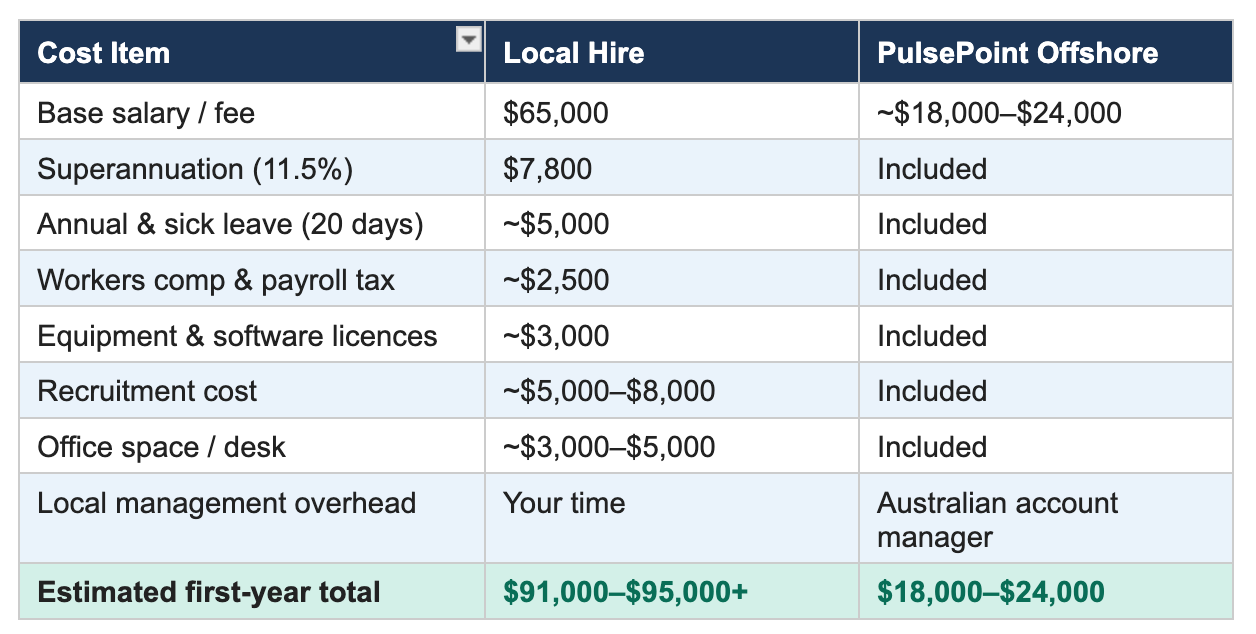
The savings are significant. But the more important point is this: the offshore option comes with all compliance, HR, payroll, equipment, and local Australian account management already handled. You get the output without the overhead.
"The businesses I work with that make this shift don't talk about it as cutting costs. They talk about it as the decision that finally gave them the capacity to grow."
This isn't an argument against local hiring
Some roles genuinely need to be filled locally. Client-facing positions, roles requiring physical presence, or senior leadership. These roles often make more sense as local hires. The point isn't that offshore is always better. The point is that you should be making the decision with the full picture in front of you.
For many of the roles that small businesses need filled; administration, bookkeeping, customer support, data entry, social media management and sales development, the case for an offshore team member is compelling. The work is the same. The quality, when managed correctly, is the same. The cost is dramatically different.
The question to ask before your next hire
Before you post your next job ad, ask yourself one question: does this role need to be performed by someone sitting in an Australian office, or does it need to be performed well?
If the answer is the latter, it's worth having a conversation about whether there's a smarter way to fill it.
At PulsePoint, we help Australian small businesses build high-performing global teams with full local oversight, so you get Australian-standard quality at a fraction of the cost. No hidden fees. No complexity. Just one transparent monthly invoice and a team that delivers.
Ready to see what the right offshore hire could mean for your business?
Book a free discovery call with the PulsePoint team and we'll walk you through exactly what's possible for your specific situation.