
A Day in the Life: What Working With an Offshore Team Member Actually Looks Like

The concept of an offshore team member makes sense in theory. But what does it actually look like on a Tuesday morning? We walk you through a real working day, in real time, so you can picture exactly what this model feels like in practice.
One of the most common things we hear from business owners who are considering offshore staffing is some version of the same question: "I understand the idea, but I can't quite picture how it would actually work day-to-day."
It's a fair thing to wonder. The concept sounds logical: a skilled professional, based overseas, managed locally, doing real work for your business at a fraction of the local cost. But without a concrete picture of what that looks like in practice, it can feel abstract.
So let's make it concrete. What follows is a walkthrough of a real working day between an Australian business owner we'll call Claire, who runs a 12-person professional services firm in Sydney, and her PulsePoint virtual assistant and administrative support team member, Marco, based in the Philippines.
At PulsePoint, we align our team members to Australian business hours. Marco starts his day at 5:30am Manila time, which is exactly 8:30am Sydney time. He and Claire begin and end work at the same moment. They are available to each other in real time throughout the entire working day, just as if Marco were sitting in the next room. The timezone difference disappears entirely from the working experience.
This is a composite of how our clients typically work with their offshore team members. The tools, rhythms, and interactions are real.
Claire and Marco's working day
The Philippines is 3 hours behind Sydney. Marco's 5:30am start in Manila is 8:30am in Sydney. They finish together at 2:30pm Manila time and 5:30pm Sydney time: a clean, shared 8-hour working day with a 30-minute lunch break.
8:30am (Sydney) | 5:30am (Manila) | Claire and Marco: both start together
The day begins at the same moment
Claire opens her laptop at her Sydney desk. Three hours earlier on the clock but the same moment in their shared schedule, Marco opens his at his desk in Manila. Both log into Slack. Marco sends a quick good morning message and confirms his task list for the day. Claire replies with one addition: a client proposal she needs finalised before their 2pm meeting. They are, from this moment, working alongside each other in real time.
8:30am – 9:00am (Sydney) | 5:30am – 6:00am (Manila) | Both: morning setup
Reviewing the day ahead
Claire checks her calendar and flags her priorities in their shared project management tool. Marco reviews the task board, picks up where he left off yesterday on the client proposal, and checks the shared inbox for anything that came in overnight. Any client emails that arrived outside of business hours are triaged and either handled by Marco directly or flagged for Claire's attention with a brief note. By 9am, both of them know exactly what the day looks like.
9:00am (Sydney) | 6:00am (Manila) | Claire and Marco: morning check-in
Daily video call
Claire and Marco have a standing 15-minute video call every morning. Marco runs through his task list, flags one item needing Claire's input. A client proposal needs her to confirm pricing before he can finalise the document. Claire gives the confirmation on the spot. She asks Marco to add one additional section to the proposal and mentions that a new client is starting next week, so she'll need an onboarding pack prepared. The call wraps up in 13 minutes. Both of them know exactly what they are doing and why.
9:15am – 12:00pm (Sydney) | 6:15am – 9:00am (Manila) | Both: parallel deep work
Independent work, real-time availability
Claire heads into back-to-back client meetings. Marco works through his task list in parallel. He finalises the client proposal with the confirmed pricing and moves it to the review column in their project management tool. He begins the onboarding pack for the new client, pulling from the approved template. He updates the CRM with notes from last week's client meetings, which Claire had dictated via a voice note shared in Slack. Because they are working at the same time, Marco can send a quick Slack message at 10:30am when he has a question about the proposal. Claire sees it between meetings at 10:45am and responds in under a minute. No waiting. No delay. The work keeps moving.
12:00pm – 12:30pm (Sydney) | 9:00am – 9:30am (Manila) | Both: lunch break
A standard break in a standard working day
Claire and Marco both take a lunch break at the same time. A normal working day, nothing unusual about it.
12:30pm (Sydney) | 9:30am (Manila) | Claire: back at her desk
Reviews and approves completed work
Claire checks the project management tool. The client proposal is in the review column. She reads it, makes two small edits directly in the document, and approves it. The onboarding pack is also ready for review. She approves it with one comment. Total time: eleven minutes. She sends Marco a Slack message: "Proposal looks great, please send to the client now. One note on the onboarding pack in the doc."
12:30pm – 2:00pm (Sydney) | 9:30am – 11:00am (Manila) | Marco: acting on approvals
Moving through the task list
Marco sends the approved proposal to the client immediately, preparing a professional covering note. He incorporates Claire's comment on the onboarding pack and finalises it. He moves on to scheduling next month's social media content using the content calendar Claire briefed at the start of the week. At 1:15pm, a client emails with an urgent request for a report that was due next week. Marco sees it at the same time as Claire. They are both online and both available. Marco Slacks Claire: "Henderson has come in asking for the report early. Happy to start pulling it together now if you can confirm the data cut-off date?" Claire replies in two minutes. Marco starts on the report immediately.
2:00pm (Sydney) | 11:00am (Manila) | Claire: pre-meeting preparation
Preparing for the 2pm client meeting
Claire has a client meeting at 2pm. Marco has already prepared the briefing notes and relevant documents and placed them in the shared folder, exactly as they discussed in their morning check-in. Claire opens the folder, reviews the notes in five minutes, and walks into her meeting fully prepared. No scrambling. No last-minute document hunting.
2:00pm – 3:30pm (Sydney) | 11:00am – 12:30pm (Manila) | Marco: Henderson report
Delivering on the urgent request
While Claire is in her client meeting, Marco works on the Henderson report. He pulls the data, formats the report using the approved template, and has a complete draft in the shared folder by 3:00pm. He Slacks Claire: "Henderson report draft is in the shared folder, ready for your review whenever you are out of your meeting." He then moves on to the remaining items on his task list: processing two outstanding invoices for Claire's approval and updating the supplier contact list.
3:30pm (Sydney) | 12:30pm (Manila) | Claire: out of her meeting
Reviews the Henderson report
Claire finishes her meeting and checks Slack. Marco's message is waiting. She opens the Henderson report, makes two minor adjustments, and sends it to the client by 3:45pm, well ahead of the original deadline. She sends Marco a quick message: "Henderson report was excellent. Great work turning that around so quickly."
3:30pm – 5:00pm (Sydney) | 12:30pm – 2:00pm (Manila) | Both: final stretch of the day
Wrapping up and preparing for tomorrow
Claire and Marco both work through their remaining tasks in parallel. Claire handles two client calls and reviews a contract. Marco completes the social media scheduling, updates the project management board with the status of every active task, and prepares a brief summary of where things stand on each active project, ready for Claire's review in the morning. They continue to exchange quick Slack messages as needed, in real time, exactly as colleagues sharing an office would.
5:00pm (Sydney) | 2:00pm (Manila) | Marco: end-of-day wrap
Summary and sign-off
Before finishing for the day, Marco sends a brief end-of-day Slack message covering what he completed, what is in progress, any items awaiting Claire's input, and what he will be working on tomorrow. It takes him five minutes to write and gives Claire complete visibility of where everything stands. He finishes at 2:30pm Manila time, the end of his 8-hour day, in sync with Claire's 5:30pm finish in Sydney.
5:30pm (Sydney) | 2:30pm (Manila) | Claire: end of day
Leaves the office on time
Claire wraps up, reads Marco's end-of-day summary, and heads home. The proposal is with the client. The Henderson report has been delivered. The new client onboarding is ready. Next month's social media is scheduled. The project board is up to date. And she is leaving at 5:30pm with less on her plate than when she arrived. Both of them have worked a clean, standard 8-hour day together, in real time, from opposite sides of the world.
What makes this work so well
The alignment of working hours changes the experience of offshore staffing entirely. There is no waiting for a response that won't arrive until tomorrow. No urgent emails falling into a gap between time zones. No feeling that your team member is operating in a different world to you.
Marco is simply available all day, in real time, for exactly the same kind of responsive and collaborative working relationship you would have with a local team member. The only difference is the cost.
When something urgent comes in, Marco is there. When Claire needs to redirect a task mid-morning, Marco gets the message immediately and adjusts. When a client asks a question that Marco can handle, it is handled without Claire being pulled in. The business operates with the responsiveness of a well-staffed local team, at a fraction of the cost of building one.
"The feedback we hear most often from clients is that within the first two weeks, they forget Marco isn't sitting in their office. The real-time availability makes the distance irrelevant."
The tools that make it work
The working relationship between Claire and Marco runs on a small stack of simple, widely used tools. Nothing exotic. Nothing that requires significant training.
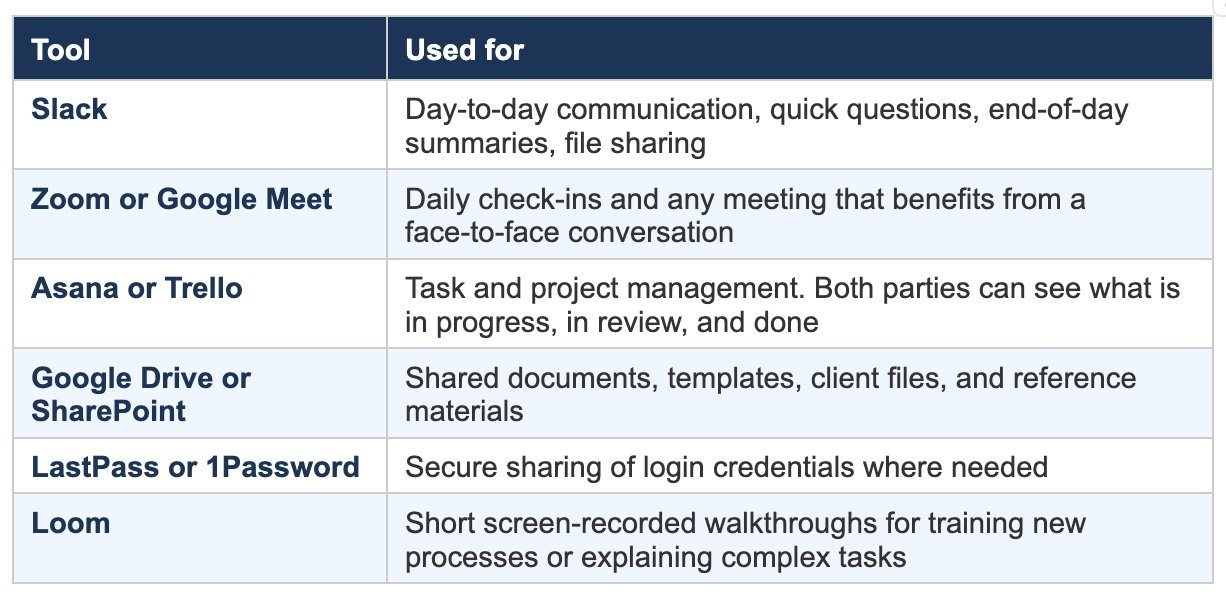
If your business already uses any of these tools, you are most of the way there. If not, they are all straightforward to set up and most have free or low-cost plans that are more than sufficient for a small team.
Ready to see what this looks like for your business?
Every business is different, and the working rhythm we would build for you would be tailored to your specific role, your industry, and how you like to work. But the fundamental model is the same: a talented, well-supported team member working your hours, available in real time, and managed with the full support of a local Australian account manager.
At PulsePoint, we set up every client relationship to work from day one. We handle the recruitment, the onboarding, the tools setup, and the ongoing management support so that you get to the Claire-and-Marco stage as quickly as possible.
Want to see what your working day could look like with a PulsePoint team member?
Book a free discovery call and we'll walk you through a working model tailored to your specific business and the role you have in mind.