
The Small Business Owner's Guide to Managing Remote Staff…(Whether They're in Bondi or Bangkok)

Managing remote team members well is one of the highest-leverage skills a small business owner can develop. Here's a practical, no-nonsense guide to doing it in a way that gets great results…regardless of where your team member is based.
Here's something that doesn't get said enough about remote work: the skills you need to manage a remote team member in the Philippines are almost identical to the skills you need to manage one working from home in Bondi.
Clear communication. Defined expectations. Measurable output. Regular feedback. The right tools. Trust.
None of these things are geography-dependent. And the business owners who struggle with offshore team members are usually the ones who haven't developed these skills for any remote working relationship, local or international.
This guide is for everyone. If you're managing local remote staff and want to do it better, it will help. If you're considering an offshore team member and want to know what good management looks like in practice, it will help. And if you've tried remote working arrangements before and they haven't gone well, it will tell you exactly why - and what to do differently.
Why remote management is a skill worth developing
The shift toward remote and hybrid work has made remote management one of the most valuable operational skills a business owner can have. Businesses that manage remote staff well have access to a dramatically larger talent pool, lower overheads, and more flexible team structures. Businesses that manage it poorly end up with disengaged team members, inconsistent output, and the nagging feeling that it would all be easier if everyone was just in the same room.
The difference is almost never about the people. It's about the systems and habits the manager has in place.
"The best remote managers I've worked with don't manage differently because their team member is remote. They just manage more deliberately. The structure that remote work forces on you is actually better practice than most in-office management anyway."
1. Set expectations before work begins
The single most common cause of remote working disappointment is a mismatch between what the manager expected and what the team member understood was expected. This gap almost always opens up at the start of the relationship and is almost always preventable.
Write a clear role description that covers not just tasks but standards. What does good look like for each key responsibility?
Define your communication expectations upfront. How quickly should messages be responded to? What channel is used for what type of communication?
Agree on working hours and overlap. When are you both available at the same time?
Clarify how you'll measure success. What are the two or three outcomes that matter most in this role?
Document your key processes before the relationship starts, not after things go wrong.
2. Build a communication rhythm that works
One of the biggest mistakes remote managers make is treating communication as something that happens reactively - only when there's a problem or a question. The most effective remote relationships have a predictable rhythm of connection that keeps both parties aligned without either one feeling micromanaged or invisible.
Use asynchronous communication as the default. Not everything needs a real-time response, and building that expectation in frees both parties to work in focused blocks.
Reserve video calls for the touchpoints that genuinely benefit from face-to-face connection - check-ins, feedback conversations, and anything complex or nuanced.
End-of-day summaries are one of the highest-value habits in remote management. A five-minute written update from your team member at the end of each day gives you complete visibility without a single interruption.
Respond to communication within a reasonable timeframe. If your team member sends you something for review and doesn't hear back for three days, the message you're sending, even unintentionally - is that their work doesn't matter.
Here's the communication rhythm we recommend for most PulsePoint clients:
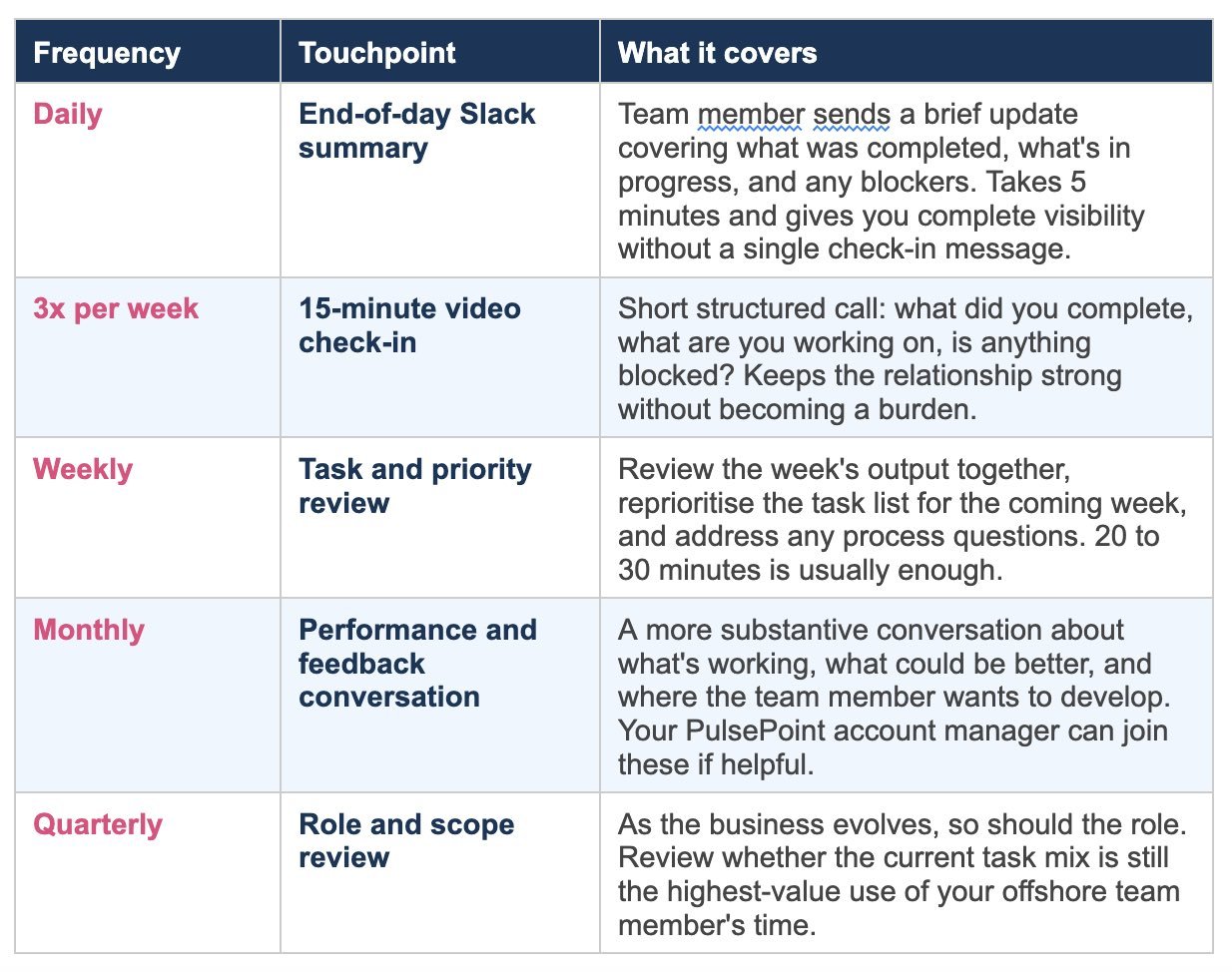
3. Manage output, not activity
This is the mindset shift that separates good remote managers from poor ones. When your team member is sitting next to you in an office, it's easy to conflate visible busyness with productivity. When they're remote, that illusion disappears - and that's actually a good thing.
Define the outputs you care about and track those, not hours logged or messages sent.
Use a simple task management tool (Asana, Trello, or Monday are all good options) so both parties have visibility of what's in progress, what's done, and what's coming up.
Review output weekly rather than monitoring activity daily. If the work is getting done to the standard you need, how it gets done is secondary.
When output isn't meeting expectations, address it directly and quickly. Don't let standards slip quietly, it's harder to correct later and unfair to the team member who doesn't know there's a problem.
4. Give feedback that actually helps
Remote team members miss out on the informal feedback that happens naturally in an office - the casual "great job on that" in the hallway, the immediate reaction when you read a document together. You have to be more deliberate about both positive and constructive feedback.
Acknowledge good work explicitly and promptly. A quick Slack message saying "the report you prepared for the Henderson account was excellent, exactly the standard I was looking for" takes thirty seconds and makes a significant difference to engagement.
When something isn't right, address it specifically and constructively. "The formatting on this document doesn't match our template" is useful. "This isn't quite right" is not.
Separate feedback on the work from feedback on the person. Always.
Ask for feedback in return. What could you do better as a manager to set your team member up for success? The answers are often illuminating.
5. Use the right tools consistently
Remote working relationships succeed or fail partly on the quality and consistency of the tools that support them. The goal is a small, simple stack that both parties use reliably, not a complicated system that creates more friction than it removes.
Pick one primary communication tool and use it consistently. Slack is the most common choice for small businesses and works well. The worst outcome is having conversations scattered across email, WhatsApp, SMS, and Slack simultaneously.
Use a shared task management tool so work is always visible to both parties. The discipline of keeping it up to date is worth the small investment of time.
Use a shared document storage system (Google Drive or SharePoint) with a logical folder structure that your team member can navigate independently.
For training and process documentation, Loom is invaluable. Record short screen walkthroughs of your key processes once and your team member can refer back to them whenever needed.
Use a password manager (1Password or LastPass) for any credentials that need to be shared securely.
6. Invest in the relationship
This is the one that gets overlooked most often, especially with offshore team members. Your team member is a professional who has chosen to work with your business. They perform best when they feel like a valued part of the team, not a transactional resource sitting at a distance.
Learn something about them as a person. What motivates them? What are their career goals? What's their life outside of work like?
Include them in relevant team updates, announcements, and wins. Being left out of information that affects the business is one of the most common complaints remote team members have.
Celebrate good work and milestones. A team member who hits their three-month mark, delivers an exceptional piece of work, or handles a difficult situation well deserves to hear it.
Be patient through the learning curve. The first four to six weeks of any new working relationship have friction. That's normal. The businesses that push through it are the ones that end up with exceptional long-term team members.
The offshore difference…and why it's smaller than you think
If you've read this far, you've probably noticed that most of what's been covered applies equally to any remote team member, regardless of location. That's deliberate.
The practical differences when managing an offshore team member are real but manageable. Time zone overlap requires some scheduling thought. Cultural communication styles can vary slightly and are worth being aware of. And the physical distance means there are none of the casual in-person interactions that sometimes compensate for poor management habits in an office environment.
But none of these differences are fundamental. They're considerations, not barriers. And for every business that has navigated them, the reward is a high-performing team member at a fraction of the local cost, managed in a way that makes the whole operation run better.
"Once you've developed the habits that make remote management work, you'll find they make all your management better — not just the offshore parts."
How PulsePoint supports you through this
Managing a remote team member well is a skill, and like any skill it gets easier with practice and with the right support around you. At PulsePoint, we don't just place a team member and leave you to figure out the management side on your own.
Our Australian account managers work with you through the onboarding period to establish the rhythms and systems covered in this guide. We provide tools guidance, process documentation support, and ongoing check-ins to make sure the working relationship is healthy and productive on both sides.
If something isn't working, we help diagnose it and fix it. If the role needs to evolve as your business grows, we support that transition. Our job doesn't end at placement…it continues for as long as your team member is with you.
Want to talk through how you'd manage an offshore team member in your specific business?
Book a free discovery call with PulsePoint. We'll walk you through exactly what the management setup looks like and make sure you feel confident before anyone starts.