
The First 90 Days: What to Expect When You Hire Your First Offshore Team Member

The first three months of any new working relationship are the most important. Here is a week-by-week guide to what those 90 days actually look like — and how to navigate them well.
The businesses that get the most out of their offshore team members have one thing in common: they invest properly in the first 90 days. Not just the first week or two, but the full quarter it takes to build a genuinely productive, well-aligned working relationship.
This guide is a practical roadmap for those 90 days. Not a theoretical framework — a week-by-week picture of what to do, what to expect, and what good looks like at each stage.
Before Day 1: Setting yourself up to succeed
The most important onboarding work happens before your team member starts. If you wait until their first day to figure out what they will be working on and how, you will spend their first two weeks in reactive mode.
In the week before your team member starts, focus on three things:
• Document the top five to ten tasks you want them handling, with enough detail that they could attempt each one without asking you. Rough notes and screen recordings are fine — they do not need to be polished.
• Confirm tool access. Make sure they can get into the systems they need from day one: email, project management, shared drives, CRM. Waiting three days for an access request to be processed is a momentum killer.
• Prepare a first-week plan. Not a comprehensive task list for the month — just a clear picture of what you want them to focus on in their first five days. Orientation, reading, a few small starter tasks.
Days 1 to 5: Orientation
Resist the temptation to load your team member with work in week one. The goal of the first week is understanding, not output.
Take them through your business: what you do, who your clients are, what matters most, and how you work. Show them around your tools and systems. Walk through the processes you have documented. Have a video call each day — brief ones are fine — so the relationship starts building.
Assign two or three small, low-stakes tasks so they can demonstrate their approach and you can start giving feedback. The goal is not to test them — it is to start the calibration process that will make the relationship productive.
Do not worry if this week feels slow. You are building the foundation. Everything that comes after depends on how solid this foundation is.
Weeks 2 and 3: Core tasks begin
In weeks two and three, your team member moves into the main responsibilities of the role. The feedback loops should be tight at this stage — you are reviewing their work closely, giving specific feedback on what is right and what needs adjusting, and building a shared understanding of your standards.
Expect some back-and-forth. Expect some rework. This is completely normal and is not a sign that the hire was wrong — it is the calibration process working as it should. Every piece of feedback you give in these weeks is an investment that reduces the need for feedback later.
A daily end-of-day summary from your team member is particularly valuable at this stage. It gives you visibility of what they are working on without requiring constant check-ins, and it surfaces questions or uncertainties before they become problems.
Weeks 4 and 5: Building rhythm and independence
By week four, a working rhythm should be emerging. The check-ins feel less like orientation and more like genuine collaboration. Your team member is starting to anticipate what you need rather than waiting to be told. The work is getting closer to your standard with less correction.
This is the stage where many business owners feel they can start to step back slightly — and that instinct is correct. The goal over weeks four and five is to transition from close feedback to periodic review. You should be checking output rather than supervising process.
It is also worth a deliberate conversation at this point about what is working well and what could work better. Ask your team member what they need more of, less of, or differently. The answers are often illuminating.
Weeks 6 to 8: Finding your stride
If the first five weeks have gone well, weeks six to eight should feel markedly different. Tasks are being completed independently and to a consistent standard. The working rhythm is established. Communication is natural. You are spending less time managing the relationship and more time benefiting from it.
This is the point where most business owners have their first real moment of appreciation for what an offshore team member actually enables. The Friday afternoon that does not involve clearing the inbox. The Monday morning where the week's content is already scheduled. The client proposal that is ready for review without them having touched it.
It does not mean everything is perfect — there will still be things to fine-tune and processes to improve. But the relationship has crossed the threshold from investment to return.
Weeks 9 to 12: Consolidation and forward planning
In the final month of the first quarter, the focus shifts to consolidation. Formalising the processes that have emerged organically. Building out the task management system to reflect what the role has evolved into. Planning what comes next.
Use week twelve as a deliberate review point. What has worked well? What would you do differently? What should the role look like in quarter two? And — importantly — what are the next tasks or responsibilities you could hand over now that the foundation is solid?
The businesses that get the most from their offshore team members are the ones that treat month three as a beginning rather than an end. Once the relationship is working, the question becomes how to expand what it can do.
"The first 90 days feel like an investment. Everything after that feels like a return. The business owners who stick with the process are consistently glad they did."
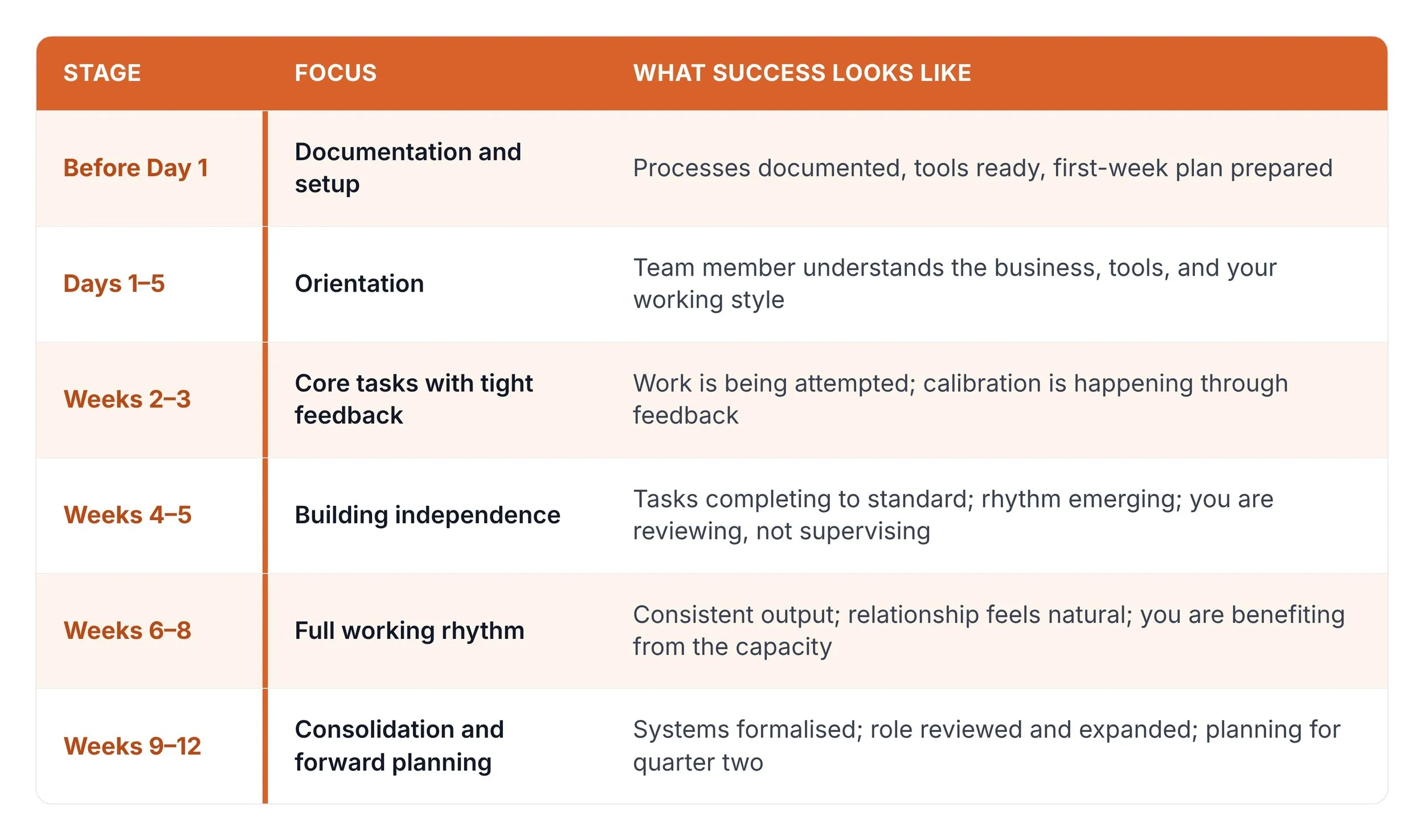
A summary: 90 days at a glance
Ready to take the next step? Visit us at www.pulsepoint.com.au or book a free discovery call with the PulsePoint team. No obligation — just a practical conversation about whether there’s a smarter way to build your business.